|
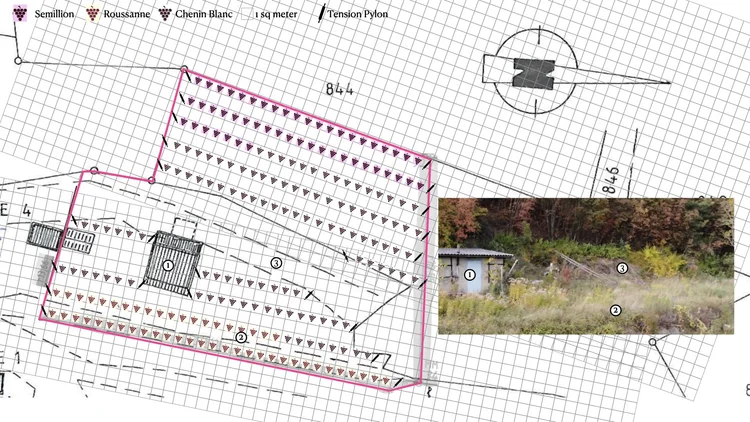
Progress at Kapitel Zwei Wine Thanks to the outstanding support from the Landwirtschaftskammer Niederösterreich (Lower Austria Chamber of Agriculture) all of my paperwork has been submitted to import my grape varietals, including Chenin Blanc, Roussanne and Sémillon, from France. I expect to hear from the review board by 6 March for the approval. I am often asked why Chenin Blanc, Roussanne and Sémillon and I guess I have two main thoughts, one pragmatic and one scientific. Pragmatically, I am not going to produce a wine in Austria from Riesling or Grüner Veltliner that will match the quality of a producer who has been working with these varietals for several decades. There are excellent wines already available in Austria, so what could I bring to the market that would be unique? Also, to be honest, while I do enjoy these varietals, they aren’t my favorites. Scientifically, climate change is impacting wine making already today and Austria is expected to get hit particularly hard with temperatures increasing 1 to 2°C more until 2050 or worse, a global temperature rise of 2°C might lead to a rise of 4°C in Austria. So why not experiment with new varietals that thrive in heat? I am inspired by the Super Tuscan wine makers of Italy, who began growing non-indigenous grapes, such as Merlot, Cabernet Franc and Cabernet Sauvignon, in Tuscany in the 1970s. Today they are world famous such as Sassicaia and Tignanello and can go for more than 100 euros a bottle. Also, I am thrilled to share the layout of my vineyard. I owe a big thanks to my fellow student and winemaker Agnes Mantler from Weingut Mantlerhof. Her suggestion to slightly slant my rows helps me squeeze in another 25 vines and cut costs by requiring less tension pylons. The vines will be planted about 1 meter between each other and then each row is about 1.5 meters apart. While this is narrow, I will be harvesting by hand so no need to make room for a tractor.
|