|
I landed in New York on 12 August and three days later I started my 15-week apprenticeship at Paumanok Vineyards. The apprenticeship is a requirement for my three-year degree at IMC Krems. Now at the halfway point, until I return to Austria, I can confidently tell you that it’s been an incredible, intensive and sometimes stressful, learning-rich experience. I am apprenticing under, Kareem Massoud, the head winemaker at Paumanok Vineyards. This article in the Northforker describes the history of the winery perfectly: Kareem was just 10 years old when he watched his father, Charles, make wine from scratch. It was a hobby born of necessity — IBM, his father’s employer, had sent him and his family to live in Kuwait for several years in the 1970s, where it is illegal to buy and sell wine. By the time the family moved to Connecticut years later, winemaking had become a passion for the elder Mr. Massoud, one he was not eager to give up. An article in the New York Times about the Hargrave family and the vineyard they operated that launched the North Fork as a wine making region inspired Charles Massoud and his wife, Ursula — who came from a family of German winemakers — to buy their own piece of land on the North Fork. By 1990, they were owners and operators of Paumanok Vineyards, and in 2018, they expanded, purchasing Palmer Vineyards. Kareem, his wife, Karen, and his brothers — Nabeel and Salim — are now carrying on the family tradition.
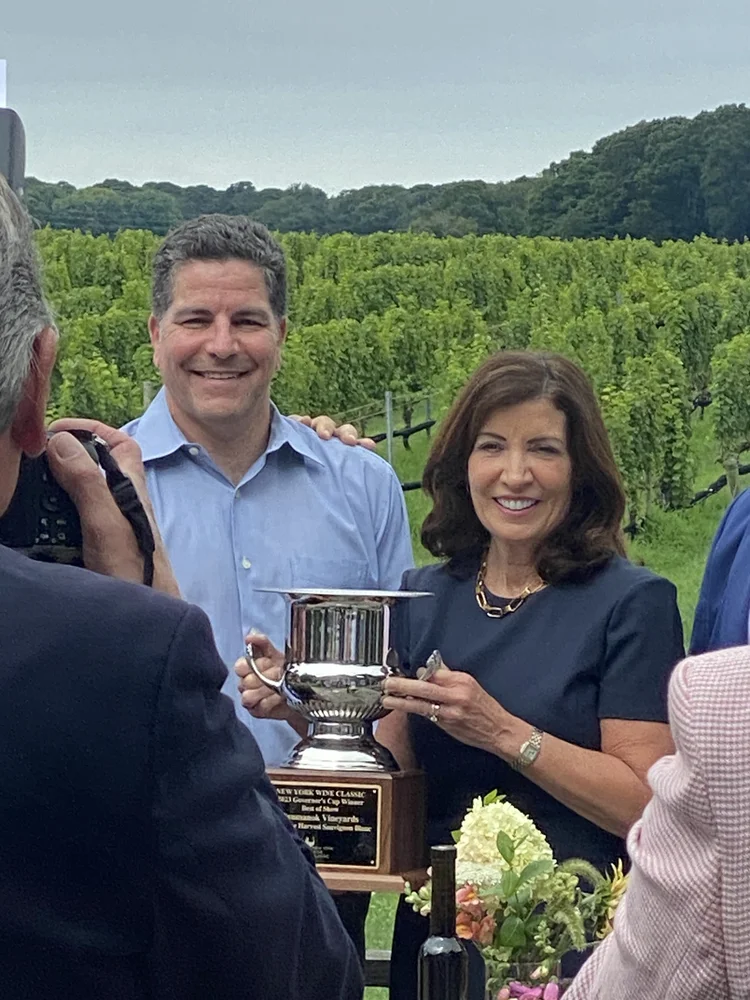
Yes, crazy coincidence that Charles worked at IBM and retired less than 10 years before I started my own IBM career. I’ve been working closely with Kareem, who was named winemaker of the year. Additionally, Paumanok also won Winery of the Year and the 2023 Governor's Cup. In fact, the Governor of NY State visited the winery a few days after I started. She presented the Cup to Paumanok for its 2019 Late Harvest Sauvignon Blanc (see photo below). Despite being an apprentice, Kareem has trusted me with some important tasks. For starters, I am conducting all of the lab analysis which he uses to determine when to harvest. This involves picking 100 random grapes from the different rows and then crushing them. I then measure the weight and the level of sugar as this will result in the percentage of alcohol of the wine. Additionally, I am measuring the pH and titratable acidity of the juice which determines the acidity of the wine — low pH will result in tart and crisp wines, but more generally pH levels impact nearly all aspects of winemaking such as aroma, flavor and age-ability. I´ve also been inoculating the Muscat, Pinot Noir, Chenin Blanc and Sauvignon Blanc with yeasts, which takes up to 90 minutes as you need to slowly reawaken the tiny single-celled microorganisms. And finally lots of cleaning. Cleaning the tanks, barrels, press and harvesting baskets using a combination of hot water, sodium carbonate or soda ash and citric acid.
|